
The 5 Things Your Parking Permit Must Have: A Complete Guide to Parking Control
It’s 5:30 PM on a Tuesday. The emails start rolling in.
“A strange car is in my assigned spot again.” “There are no visitor spots left for my client meeting tomorrow.” “Why am I paying an HOA fee if I can’t even park where I live?”
Sound familiar?
If you’re a property manager, an HOA board member, or a facilities director, you know that parking isn’t just about asphalt. It’s about emotion. A chaotic parking lot is one of the fastest ways to create resident dissatisfaction, lose tenants, and project an image of unprofessionalism. It’s a constant source of complaints, a security risk, and a logistical nightmare.
The obvious solution, of course, is a parking permit system.
But here’s the hard truth I’ve learned from years in the parking management industry: simply printing a piece of paper with “PERMIT” on it won’t solve your problem. In fact, a poorly designed parking permit can create more work, more confusion, and more frustration.
An effective permit is more than a pass. It’s your primary tool for communication, enforcement, and security. It’s the cornerstone of your entire parking management strategy.
So, how do you create a permit that actually works? It comes down to five non-negotiable features. If your current permits are missing any of these, you’re fighting an uphill battle.
-
Unmistakable, At-a-Glance Visibility
The number one job of a parking permit is to be seen. Your enforcement team—whether that’s a dedicated security guard, your property staff, or a third-party towing company—needs to be able to identify a valid (or invalid) permit in seconds.
We’ve all seen the enforcement officer squinting through a rain-streaked windshield, trying to read a permit that’s sun-faded, “accidentally” flipped over on the dashboard, or the size of a postage stamp. This is inefficiency at its worst.
Your parking permit system fails if it requires close-up inspection.
Why Visibility is Your First Line of Defense
A bright, clear parking hang tag or a high-contrast parking decal is an instant visual deterrent. It screams, “This lot is monitored, and the rules are enforced.”
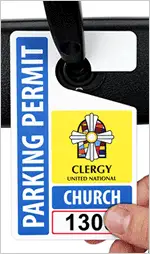
- Parking Hang Tags (Rearview Mirror): This is the gold standard for visibility. They are placed at the perfect eye level for enforcement. They are also easily transferable for residents who own multiple cars (if your rules allow) and can be removed to prevent sun damage or theft.

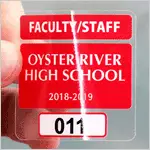
- Parking Decals (Window Stickers): These are fantastic for long-term, non-transferable permits (like multi-year staff parking). A static-cling parking decal is placed on the inside of the window, while adhesive versions go on the outside (often on a bumper or motorcycle fork).
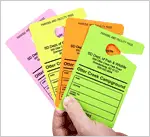
 Pro-Tip: The Power of Color-Coding Never, ever use a one-color-fits-all approach. Color is the fastest way for the human brain to categorize information. A smart parking management plan uses color to segment parking populations at a glance:
- Blue = Resident (Building A)
- Green = Resident (Building B)
- Red = Staff
- Yellow = Visitor
Now, your enforcement staff doesn’t even need to read the permit. They just need to know that a “Red” permit in a “Blue” zone is a violation. Change the primary color with each renewal year (e.g., 2024 is blue, 2025 is green) to instantly invalidate all old permits.
-
A Clear, Prominent Expiration Date
A parking permit without an expiration date is a ticking time bomb.
Think about it. A tenant moves out. An employee quits. A student graduates. What happens to their permit? Without a clear “Valid Thru” date, that permit often stays in circulation. It gets passed to a friend, sold online, or simply continues to be used by the former resident who knows the rules.
This is what I call “permit creep,” and it’s how a perfectly balanced 100-spot lot ends up with 120 “valid” permits, leaving your current, paying residents furious.
Make the Date Impossible to Miss
The expiration date should be one of the largest elements on the permit. Don’t hide it in 8-point font at the bottom.
- Good: EXPIRES: 12/31/2025
- Bad: Valid for the 24-25 Season (This is vague. When does the season end?)
This single feature is your most powerful tool for “refreshing” your parking database. It forces all users to re-register their vehicles annually. This allows you to purge old data, collect updated vehicle and contact information, and ensure that only current, authorized individuals have parking control access.
For disposable visitor passes, this is even more critical. A paper dashboard pass must have a large, blank area for writing in the specific date and time of expiration.
-
Unique, Sequential Serial Numbering
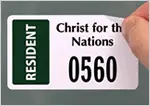
This is the feature that transforms your permit from a “dumb” piece of plastic into a “smart” asset. Every single permit you issue must have a unique identification number.
This number should be bold, legible, and the most prominent feature on the permit (after the color and expiration).
From “Pass” to “Database Key”
This unique number is the lynchpin of your entire parking control database. Whether you use sophisticated parking management software or a simple spreadsheet, this number is the key.
When you issue Permit #0001, your records must show:
- Permit ID: #0001
- Issued To: Jane Doe
- Apt / Office: #201
- Vehicle Make/Model: Blue Honda CR-V
- License Plate: ABC-123
- Phone Number: (555) 555-1212
Why This is a Game-Changer for Enforcement
This database changes everything. A car is parked in a fire lane. Instead of an immediate, costly, and relationship-damaging tow, what if you could do this?
- Your guard sees Permit #0001 on the dash.
- They look up #0001 in the database and find Jane Doe’s number.
- They call: “Hi Jane, this is security. Your CR-V is in a fire lane. Can you please move it in the next 5 minutes?”
You’ve just enforced the rule, built goodwill, and avoided a screaming match.
This system also spots unauthorized parking and fraud instantly. What if you see Permit #0001 on a red Toyota? You know immediately the permit is being used fraudulently (or on an unregistered vehicle) and can take appropriate action, from booting to towing.
-
Robust Anti-Fraud & Security Features
Let’s be realistic. The moment your parking spaces become a scarce, valuable commodity, people will try to copy your permits. A simple permit printed on cardstock can be duplicated at a local print shop for a few dollars.
Your parking permit system is only as secure as its permits. You must invest in features that make counterfeiting difficult, expensive, and obvious.
Low-Tech, High-Impact Security
You don’t need a million-dollar budget. Many of the most effective anti-counterfeiting features are simple and affordable:
- Holographic Foil: This is the #1 way to stop casual counterfeiting. A holographic overlay, stamp, or strip is nearly impossible to replicate with a scanner or color printer.
- Custom Die-Cuts: Instead of a simple rectangle, have your hang tags cut into a custom shape (like your company logo or building silhouette). This is another major barrier for counterfeiters.
- Micro-printing: Tiny text hidden in the border or design that blurs or disappears when scanned.
- Tamper-Evident Materials: For parking decals (stickers), use materials that self-destruct or leave a “VOID” pattern when someone tries to peel them off to move them to another vehicle.
High-Tech Integration: QR Codes & RFID
For a truly modern and efficient system, link your physical permit to your digital database.
- Unique QR Codes: Printing a unique QR code on each permit allows your enforcement staff to scan it with a smartphone. This can instantly pull up the database record (Jane Doe, Blue Honda CR-V), confirming the permit is valid and being used by the correct person.
- RFID (Radio-Frequency Identification): For large campuses or garages, this is the ultimate solution. An RFID tag is embedded in the permit. An enforcement vehicle with a reader can simply drive through the lot and automatically scan dozens of permits in minutes, instantly flagging any that are invalid, expired, or in the wrong zone.
-
Specific Zone & User-Type Designations
Finally, your permit needs to clearly state who it’s for and where it’s valid. This is absolutely critical for properties with multiple lots, garages, or user groups.
A generic “Resident” permit is useless if you have three different residential buildings with three different parking garages. This ambiguity creates chaos, as residents from Building A (with the less desirable lot) will inevitably poach spots from Building B (with the covered garage).
Your permit design must clearly answer these questions at a glance:
- Who is this for? (e.g., Resident, Staff, Visitor, Vendor, Student Commuter)
- Where is it valid? (e.g., Lot C, Garage B Only, Surface Lots, North Campus)
This feature empowers users to self-regulate. A new employee will see “Staff – Lot C” on their permit and know exactly where they are supposed to park. There’s no confusion.
It also makes your parking enforcement rules black-and-white. Your guard doesn’t need to memorize a complex set of rules. They just need to know that in “Garage B,” only “Garage B” permits are allowed. This clear, fair designation is what makes your rules stick.
Conclusion: Your Permit is Your Most Important Tool
Stop thinking of a parking permit as just a piece of paper. Start seeing it for what it is: the cornerstone of your entire parking management operation.
A well-designed permit does more than just grant permission. It builds a foundation of control, fairness, and security. It is your best and most proactive tool for:
- Drastically reducing resident and employee complaints.
- Stopping unauthorized parking and permit fraud.
- Protecting the value of your parking spaces.
- Improving your property’s security and professionalism.
- Freeing up your staff’s time to focus on more important matters than playing “parking police.”
By ensuring your permits have these five essential features, you transform a simple tag or sticker into a powerful system that brings order to the chaos.
Related Posts
 Starved for student parking in Morristown, NJ
 Fake permits make parking a beach in New Hampshire coastal town
 The end of free disabled parking?
 Why a residential parking permit program won’t work in New York
 App takes the pain out of paying high prices at NY parking garages
 Brooklyn to feature North America’s largest automated parking facility

Category: Parking, Parking management
Recent Comments